Sunday, August 12, 2012

DBK-21 first light

Last night I was hoping to try out the new DBK-21 cam on Jupiter and maybe catch some Perseid meteor shower action as well. I setup right before dark, and perhaps a little too hastily. GOTO performance was not very good, worked well at first but had some issues later in the evening. Some were good, others well not so much. I attribute that to targets being on the meridian. not too familiar with how this affects EQ observing, but it seemed to have an effect last night. At any rate, I setup and in my boredom, decided to try to image Uranus. I knew not to expect any detail, so believe it or not I am actually happy with the following image of the little blue dot. Imaged at 0542ut, this is a process of 50 frames, stacked, aligned, and RGB alignment in registax v6. C8 on Sirius EQ-G. No barlow. DBK-21 camera from Imaging Source.
Uranus, 0542ut C8/DBK21

I continued to play around with different targets, suffering some way off GOTO performance. Still not sure what all that was about, but I did not pay proper diligence to my normal setup. Was pretty rushed with it.

I was pretty stoked to see Jupiter rise above my eastern obstructions around 0245 local. I had started to dial in the settings on the camera when a cloud bank rolled in. I didn't even get to capture one .avi sequence. One thing was pretty apparent is that the uv/ir cut filter required for this camera is extremely critical on Jupiter. Color was obviously skewed, but there was a hazy halo around the entire planet that was very distracting. I am assuming that was IR light washing out the edges. I will have to order a good uv/ir blocking filter. I will try again next week though. Somewhat pissed that I had waited so long for Jupiter and the height of the Perseid meteor shower only to be clouded out, I decided to pack it in. To add insult to injury, it started raining so I had to do a very fast breakdown. No harm done, but hopefully next week I will have better results to post up.


Sunday, July 29, 2012

EQMOD Scope control demo from tonight 7/28

Just a quick video I made tonight during my first light with the new Orion Sirius mount running EQMOD/EQASCOM. Had lots of fun tonight despite mediocre skies.

Saturday, July 28, 2012

Lots of changes

Last week I traded my beloved Lunt 60 solar scope. I loved that little scope, but I decided to trade for a mount more suitable for AP work. After we cycle down from the solar maximum, I will pick up a used PST to satisfy my urge for solar imaging. I ended up trading for an Orion Sirius EQ-G (little brother to Atlas mount) with a deforked fastar-compatible C8 with starbright coatings. Also included was the Celestron pelican case and cases for everything else. I got tons of accessories and netbook to control the mount/scope via EQMOD/EQASCOM. The mount itself is only 7 months old and used a handful of times.

I swapped out the tripod (1.75"OD legs) with the sturdier tripod (2.0"OD legs) from the CG-5 asgt mount. I ordered and installed the Orion 16" SVP Pier extension, which is compatible with both tripods. After learning how to polar align the cg-5, I decided I wasn't going to crawl on the ground anymore. I must admit, with the scope and mount attached to the pier extension, it is quite a formidable setup.


Another shot of the "Twins":


I put the trade scope on the CG-5 ASGT mount and plan to use for visual use or planetary imaging while I do my DSO subs with the NS8SE OTA on the Sirius mount.

About the Sirius mount. There sure isn't as much review information on the internet as it's big brother, the atlas. The motors and controls are the same, however the payload limit of this system is rated at 30lbs. I figure my OTA with eventual guidescope package and imager will place it between 16-18 lbs depending on the imager used. A little over half of the visual rating, it means I will have to give extra attention to balancing if I plan to be successful with AP. I am also thinking real seriously about going the hyperstar route next year at tax time. 

The motors on the Sirius mount are amazingly quiet when compared to my CG-5. The CG-5 is pretty loud, and although it never really bothered me before, compared to the Sirius I can see where they can get annoying. The mount was purchased originally without a hand controller, so I connect to the mount using EQMOD/EQASCOM and sync goto's with Cartes du Ciel. I really didn't like CdC at first, being familiar with stellarium and all, but I have to admit that it has grown on me. Uncle Rod pointed me in the right direction to get it setup in a similar fashion to stellarium. 

About EQMOD. This program is simply amazing, giving me much more control and trouble-free operation than NexRemote ever could. It is a bit of informational overload, due to the never-ending list of features. The trick is to take several nights and take small bites, rather than try to chew on it all at once. I took several nights learning different features and over the course of last week, I feel pretty confident in using it. I downloaded the voicepack and installed it so now the mount talks to me when operating. Audible alerts and announcements are completely customizable, allowing any sound or .wav to be assigned to nearly every aspect of mount/scope operation. I am currently compiling some star trek computer sounds to plug in, because yes, I am that big of a nerd. I will say this about EQMOD, it is light-years ahead of NexRemote.

So my plans are, for the moment...to sell the Nexstar 8 altaz mount (350 with manual, nexremote software, HC extender, HC, computer/hand control cable, no power cord) and purchase an Orion SSAG package. I also plan on selling my DMK21 monochrome imager (300) and purchasing the color equivalent DFK/DBK21 for planetary imaging (since only needed monochrome for h-alpha imaging).

Tonight will be first light with this new setup. Hoping for clear skies and good luck!


Wednesday, July 4, 2012

4th of July sun in h-alpha

A collage of solar shots taken today between 1550 and 1700ut. Lunt 60 / DMK-21. Enjoy~


Sunday, July 1, 2012

Solar Goodness and First Light with CG-5 ASGT

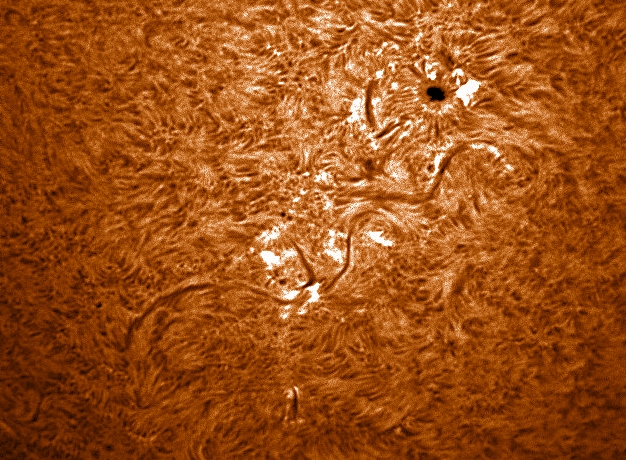
Yesterday turned out to be a really good day. I woke up and took immediate note of the swaying tree in the front yard and determined that it would probably be too windy to try for any solar imaging. As I got around, I logged online to see some amazing prominence shots on the GONG h-alpha solar monitor site. I decided to brave the wind, and I am glad that I did. Imaging yesterday gave me a stress-free day (no transit, no public outreach) to really experiment and play with the IC capture software that came with the DMK-21. As such I think I found a sweet spot on the gamma slider bar where the darker, contrasty details really pop out at you. I did some imaging, and active regions AR1515 and 1513 took the cake. I was amazed out how much detail I was able to get with the DMK and the single-stack Lunt 60tha.


After processing the above images, I became keenly aware that it was saturday evening and I was very bored, and very broke. I decided to give my  Celestron CG-5 ASGT mount a try. I didn't really have the energy for a full blown imaging session, and I believe the moon was at 91 percent illumination anyway. Honestly I just didn't have the energy to drag out all the apparatus necessary. I decided to make it a visual session only, that would give me time to figure out polar alignment. You see, I have read many a manual and tutorial, but have never actually done a polar alignment routine. I dragged the behemoth out side, set the correct leg to North, and began the procedure just as soon as I could see Polaris. Turns out, alignment was a snap with the polar scope. What I didn't like though, was that in order to get the optics perfectly aligned, I had to fudge a little from the index marks. I will look into this more, I was kinda flying by the seat of my pants. After everything was aligned, I went to work. One thing that I will say is that it sure was different to align a GEM mount than the alt-az. I like being able to choose which stars I align to, my choice this time of year being Vega and Spica. The mount forced me to choose between western stars, then I could add eastern calibration stars. Not to bad, just different. I chose Spica and Alkaid, then added Vega as a calibration star and I was off to the races. First target: Albiero. Next target: M57. All of my gotos were off, but I attribute this to a.) index mark change in home position during initial startup (error due to my inexperience) and b.) pitiful power cord and partially charged battery. I did have a runaway goto indicative of a low voltage problem, but as mentioned above, the power cord is the weak link here and I have observed about 5 sessions on my power tank, so I know it has to be about done. I mean, the gotos were not that bad off, just usually slightly out of the FOV on the top of the eyepiece.

Other impressions? This mount seems rock solid. Some old salts will probably laugh at that statement, as one of the chief complaints of the mount is that it isn't very solid. My experience coming from the NexStar 8SE with it's overworked mount and  1.50" skinny tripod legs. The ASGT with the 2" tripod legs makes a huge difference. Vibrations dampened quickly, and I was actually able to focus manually with out using four-letter words and waiting on the vibrations to settle down. If this mount seems rock solid, I cannot wait to see what the Orion Atlas is like. 

To sum up, I was very pleased with the first performance of this mount. Tracking seemed dead-on, nothing appeared to travel in the eyepiece (true test will be photography). Setup is a bit more involved, but really only slightly so. My problems with gotos are probably user error or power deficiency. I can live with that. 


Sunday, June 24, 2012

Amazing night part 2: Moon/Saturn

Although seeing was not the best, I still managed some decent shots of the moon and a so-so shot of Saturn. These are with the imaging source DMK-21. Some of them seem a little over-sharpened. It is hard not to play Horatio from CSI with registax, "Enhance......enhance.....enhance"  Enjoy!


Amazing night part 1: Deep sky

Last night was one of those rare nights when everything worked perfectly together to create a very memorable night. Weather was nice, mediocre seeing limited magnification, but no wind, nice temps, and no dew! My goal for the night was to bag supernova SN2012cg in NGC 4424 in the constellation Virgo. I had tried earlier in the week when I read Rod Mollise's facebook post and saw his picture. He has a Mallincam Xtreme and bagged it with his C8 and a 14 second exposure. I thought since I had a c8 and my Mallincam has a 14 second limit, I should be able to get it. Wind, time, and bad alignment made sure that it didn't happen earlier in the week. I vowed to try again on saturday evening, and did so. Got lucky this time. With the success of imaging the supernova, I decided to try my hand at some other deep sky targets that I had never tried. Here are the results...


Swan Nebula:


m64:


m51:


m13:


Albiero: